Inlays vs. Onlays vs. Crowns: Which Dental Restoration Do You Need?
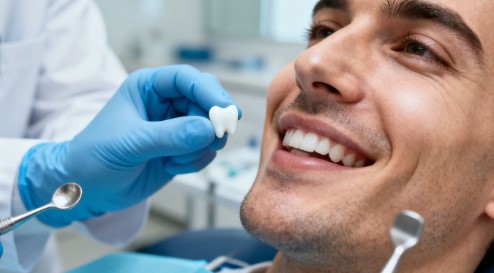
Choosing the right restoration for a damaged tooth can be confusing with so many technical terms coming at you in the dental chair. Dentists categorize these treatments based on how much natural tooth structure is missing or compromised. Whether you need a small reinforcement or full coverage, understanding the differences helps you make a confident decision with your provider. At Aventura Dentistry, Dr. Diana Wohlstein draws on more than 30 years of experience to recommend the most conservative option that will still last.
What Is a Dental Onlay, Exactly?
An onlay is a middle-ground restoration designed to rebuild the biting surface of a tooth when damage is too extensive for a simple filling. Unlike a filling, which sits inside the tooth, an onlay covers one or more cusps, the raised points on your teeth, to protect them from fracturing. It is crafted in a lab from durable ceramic or porcelain, giving a precise fit that reinforces structural integrity while sparing as much healthy tooth as possible. By targeting only the damaged sections, inlays and onlays offer a conservative alternative to more invasive work.
Inlay vs. Onlay: How Dentists Decide Which One You Need
The right treatment depends on the size, depth, and location of the damage. A clinical exam, usually with a physical impression or a digital scan, shows how much enamel remains to support a restoration. The core distinction is straightforward: an inlay fits within the cusps of the tooth, while an onlay extends over one or more cusps to shield them.
When Is an Onlay Better Than a Crown?
An onlay is often preferred over a full crown when the damage does not span the entire tooth. A crown replaces the whole visible portion above the gum, which requires reducing a substantial amount of healthy enamel. An onlay preserves much more of the original tooth. The comparison below clarifies how these options differ.
| Restoration Type | Target Damage Area | Tooth Reduction Needed | Level of Coverage |
|---|---|---|---|
| Filling | Internal cavity only | Minimal | None |
| Inlay | Interior surface between cusps | Low | Low |
| Onlay | Cusp and internal coverage | Moderate | Medium |
| Crown | Full tooth surface above gum | High | Full |
When a specific cusp shows micro-fractures without the whole tooth being compromised, an onlay acts as a protective cap that stabilizes the area without committing to a porcelain crown.
Porcelain Inlay Benefits Over Traditional Fillings
Choosing porcelain offers a meaningful upgrade in both appearance and longevity compared with standard composite or silver fillings. These lab-fabricated pieces bond securely to the tooth, minimizing the gaps that can allow secondary decay to develop. Because porcelain mimics the natural luster and translucency of enamel, the finished result is visually difficult to distinguish from your own teeth.
How Much Tooth Structure Determines Your Best Option
Preserving natural enamel is a core priority in modern restorative dentistry, since a heavily reduced tooth is a weaker tooth. When evaluating your options, your dentist assesses the remaining hard tissue to determine whether the tooth can support a bonded inlay or needs more robust protection. Several factors influence that call:
- The total volume of tooth structure lost to decay or injury.
- The likelihood of heavy bite forces on the reconstructed cusps.
- The position of the tooth within the dental arch.
- Any history of teeth grinding or jaw clenching.
If fixing the decay would require removing a large portion of enamel, a crown becomes the safer, more durable choice. If the base of the tooth is healthy and only unsupported cusps are at issue, an onlay balances strength and preservation well.
What to Expect Getting an Inlay, Onlay, or Crown
A permanent restoration typically takes two visits. During the first, the tooth is prepared, cleaned of decay, and scanned or impressed with high precision so a technician can fabricate a custom piece matched to your anatomy. You wear a temporary restoration in the meantime to protect the tooth. At the second visit, the final piece is bonded or cemented and the bite is checked and refined.
How Long Each Restoration Type Typically Lasts
Durability depends heavily on daily habits, especially consistent brushing and flossing along the gumline. Quality porcelain and ceramic restorations generally provide many years of service, and with good professional cleanings and home care they often last well over a decade. According to the American Dental Association, the lifespan of any restoration depends significantly on oral hygiene and habits like grinding.
Conclusion
Choosing between an inlay, an onlay, and a crown comes down to your specific tooth and the extent of the damage. Inlays and onlays are excellent for preserving natural structure, while crowns provide full protection when a tooth is substantially compromised. A professional evaluation is the only way to know which fits your situation. To discuss your options, visit our Aventura office.
Frequently Asked Questions
Will I feel any pain during the restoration process?
Most patients report little to no discomfort, since the area is numbed with local anesthetic before the tooth is prepared.
Can porcelain restorations chip over time?
Porcelain is strong, but it can chip under extreme force, such as chewing ice or using teeth to open packages.
Are there visible differences between inlays and natural teeth?
When placed by an experienced dentist, inlays are color-matched and usually indistinguishable from natural enamel.
How soon can I eat after receiving my permanent restoration?
Once it is cemented and the bite is checked, you can generally eat normally, though mild sensitivity may last a day or two.
Is it possible for a cavity to develop underneath an onlay?
It is less common than with traditional fillings, but secondary decay can occur at the margins if hygiene is neglected.
Are these treatments suitable for children?
Inlays and onlays are typically reserved for permanent adult teeth, since children's teeth are still developing.
About the Author
Aventura Dentistry is a general and cosmetic dental practice located at 2925 Aventura Blvd, Suite 203, in Aventura, Florida. The practice is led by Dr. Diana Wohlstein, DMD, who has over 30 years of dental experience and also serves patients at a second South Florida location in Sunrise. Her team of hygienists and patient coordinators provides preventive, restorative, and cosmetic dentistry including crowns, veneers, inlays and onlays, implants, and Invisalign.
Medical Disclaimer
The information provided in this article is for educational purposes only and does not constitute professional medical or dental advice, diagnosis, or treatment. Only an in-person examination can determine which restoration is appropriate for your tooth. Always seek the advice of your dentist or other qualified health provider with any questions regarding a dental condition or treatment. Never disregard professional advice or delay in seeking it because of something you have read here.
Blog Post Author

Contributed by DentalROI
DentalROI provides relevant dental content to help providers educate patients. The statements, services, and products referenced in this article have not been evaluated by the Food and Drug Administration, and they are not intended as a substitute for professional medical advice, diagnosis, or treatment. Always seek the advice of your dental provider with any questions or issues you may have. Specific recommendations may vary in different circumstances, so individual consultation is important.


